Coding and agentic execution
M3 is built for repository-level coding, autonomous task decomposition, tool invocation, and multi-step workflows that can run for many hours.
Officially released June 1, 2026
Coding and agentic frontier with native multimodality
MiniMax M3 is the latest M-series model for coding, tool use, long-horizon agents, and visual understanding. The official API supports a 1,000,000-token context window plus text, image, and video input.
Context window
1,000,000
tokens in the official API model profile
Input modalities
Text · Image · Video
native multimodal input through M3-compatible APIs
API formats
Anthropic · OpenAI
supported by this gateway and MiniMax upstream
Reasoning control
Adaptive · Disabled
request-level thinking modes for MiniMax M3
MiniMax M3
MiniMax positions M3 around frontier coding and agentic execution, million-token context, and native multimodal understanding. The combination matters more than any isolated benchmark score.
M3 is built for repository-level coding, autonomous task decomposition, tool invocation, and multi-step workflows that can run for many hours.
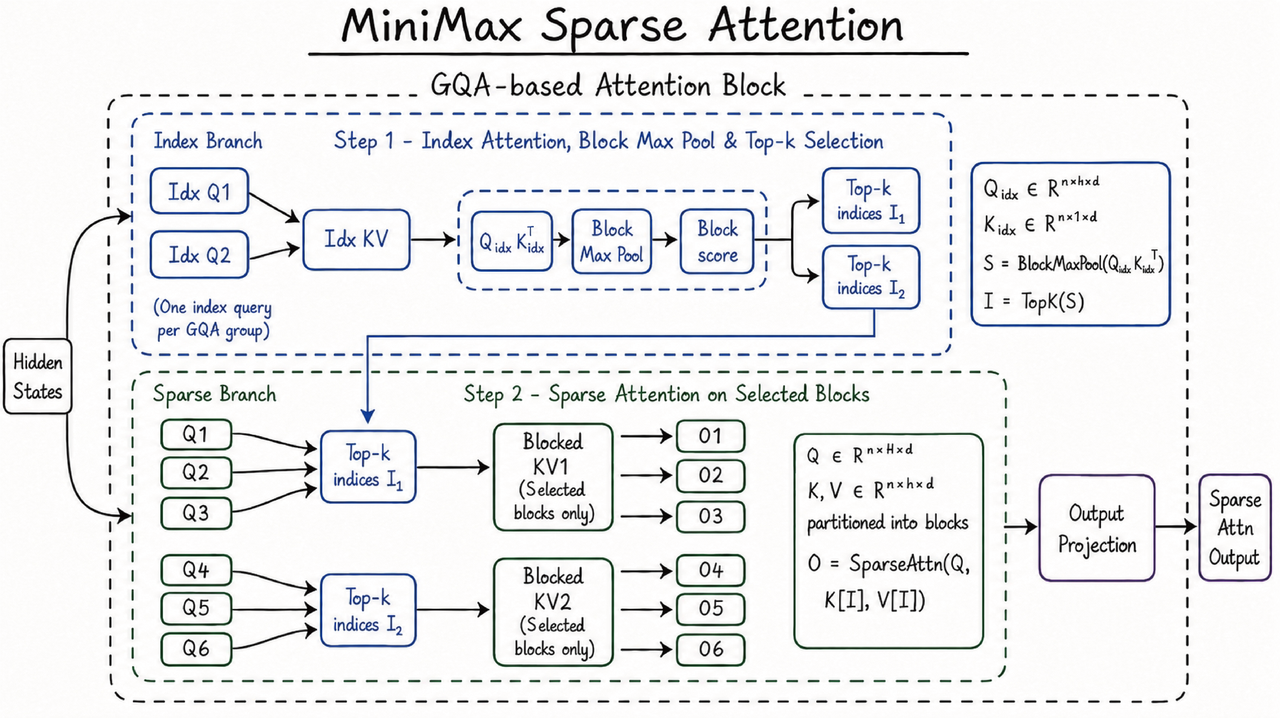
The proprietary MSA architecture selects relevant KV blocks before sparse attention, allowing MiniMax M3 to scale its official API context window to 1M tokens.
M3 accepts image and video alongside text. MiniMax says multimodal training began from the start of pretraining rather than being added as a separate adapter.
Official evaluation
MiniMax reports strong results across software engineering, terminal, browsing, tool-use, and computer-use evaluations. These are vendor-published results, and several benchmarks were run on MiniMax infrastructure with the scaffolds described in the official report.
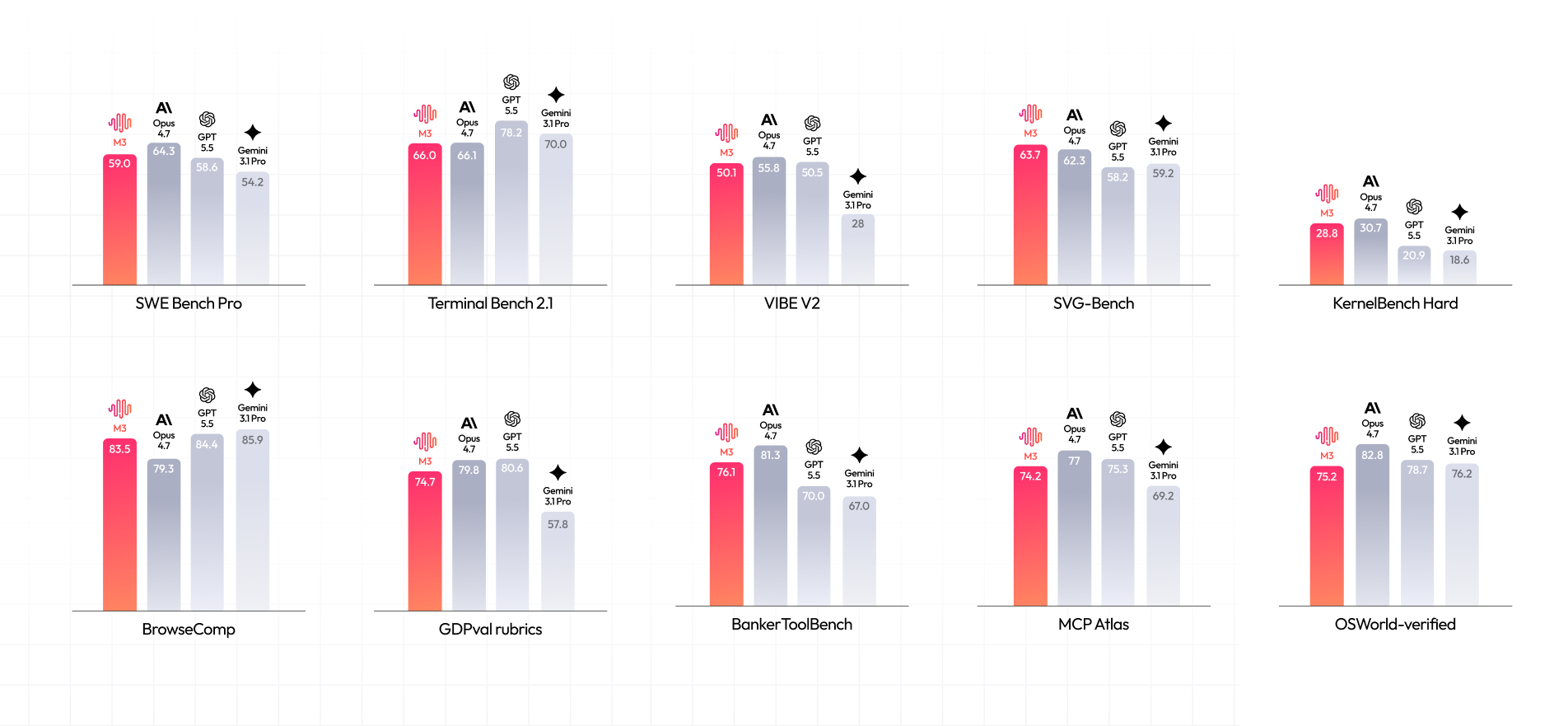
83.5
MiniMax-reported browsing and information retrieval score.
~12 h
18 commits and 23 experimental figures in an official case study.
9.4×
147 submissions and 1,959 tool calls over roughly 24 hours.
Long-context architecture
MSA adds an index branch that scores and selects KV blocks, then runs sparse attention over the selected blocks. MiniMax reports that this design keeps effective context coverage while reducing long-context compute.
API integration
The model ID is exactly MiniMax-M3. Existing clients can keep their current endpoint and change the model field; this deployment preserves M3 multimodal blocks, tools, and thinking controls.
Thinking is off when omitted. Set thinking.type to adaptive to enable thinking blocks, and preserve the complete assistant content list in later tool-use turns.
curl https://minimax-m2.com/api/v1/messages \
  -H "content-type: application/json" \
  -H "x-api-key: $MINIMAX_API_KEY" \
  -H "anthropic-version: 2023-06-01" \
  -d '{
    "model": "MiniMax-M3",
    "max_tokens": 2048,
    "thinking": {"type": "adaptive"},
    "messages": [{"role": "user", "content": "Review this design."}]
}'Thinking is on when omitted. Use thinking.type=disabled for direct responses, and reasoning_split=true when you want reasoning returned separately.
from openai import OpenAI

client = OpenAI(
    api_key="YOUR_MINIMAX_API_KEY",
    base_url="https://minimax-m2.com/api/v1",
)

response = client.chat.completions.create(
    model="MiniMax-M3",
    messages=[{"role": "user", "content": "Review this design."}],
    max_completion_tokens=2048,
    extra_body={"reasoning_split": True},
)
Effective gateway pricing is returned by GET /api/v1/models. Standard service tier is supported; priority requests are rejected until tier-aware billing is available. MiniMax upstream pricing varies by input length and service tier.
Documentation
Capability and benchmark statements on this page are grounded in current MiniMax documentation. Follow the source links for request limits, evaluation methodology, and pricing changes.
MiniMax M3 is the latest M-series model for coding, agentic reasoning, tool use, long-context tasks, and native image/video understanding. MiniMax officially released it on June 1, 2026.
The official Anthropic and OpenAI compatibility documentation lists a 1,000,000-token context window. The MiniMax product page describes 512K as the guaranteed minimum usable context and up to 1M through the API.
Yes. Official API documentation supports text, image, and video input for MiniMax M3. Image formats include JPEG, PNG, GIF, and WEBP; video formats include MP4, AVI, MOV, and MKV.
On the Anthropic-compatible endpoint, set thinking to { type: adaptive }; thinking is off when omitted. On the OpenAI-compatible endpoint, thinking is on when omitted and can be disabled explicitly.
No independent verification is claimed here. The scores and long-horizon cases shown are MiniMax-reported results. The official release report documents the evaluation scaffolds and which runs used internal infrastructure.
Start with representative coding, tool-use, long-context, and multimodal tasks, then compare quality, latency, token use, and failure recovery in the scaffold you plan to ship.