Streaming chat workspace
Test MiniMax-M2’s reasoning loop with live <think> traces, conversation search, and persona switching designed for red-teaming.
A 230B-parameter sparse MoE with 10B active parameters, tuned for coding, browsing, and long-horizon agents.
230B sparse MoE • 10B active per token • 128K interleaved context • SWE-bench Verified 69.4 · Terminal-Bench 46.3 · BrowseComp 44
Ship development copilots, research agents, and finance analysts with MiniMax-M2’s open weights, free MiniMax Agent console, and limited-time complimentary APIs.
Or launch a prebuilt MiniMax-M2 expert profile
Helps you solve complex maths problems with step-by-step reasoning and LaTeX formatting.
Generates production-ready code, reviews implementations, and explains trade-offs.
Builds polished UI components with responsive layouts and accessibility baked in.
Extracts insights from long documents, summarises content, and supports multilingual analysis.
Crafts marketing copy, scripts, and narratives tailored to your tone and audience.
A general-purpose MiniMax-M2 assistant ready to help with reasoning, coding, and knowledge tasks.
Try guided MiniMax-M2 prompts
Hands-on demos using the same harnesses as our public benchmarks
Launch ready-made scenarios that highlight interleaved thinking, tool execution, and coding depth in realistic environments.
Test MiniMax-M2’s reasoning loop with live <think> traces, conversation search, and persona switching designed for red-teaming.
Replica endpoints for OpenAI and Anthropic contracts let you drop MiniMax-M2 into existing SDKs in minutes.
Run notebook-driven agent evaluations with BrowseComp and Terminal-Bench scaffolds to audit MiniMax-M2 locally.
Architecture decisions behind MiniMax-M2
MiniMax-M2 combines a sparse 230B-parameter core with interleaved thinking traces so teams can debug, govern, and extend agents with confidence.
1/32 expert routing ensures only ~10B parameters fire per token while the full 230B capacity remains available when needed.
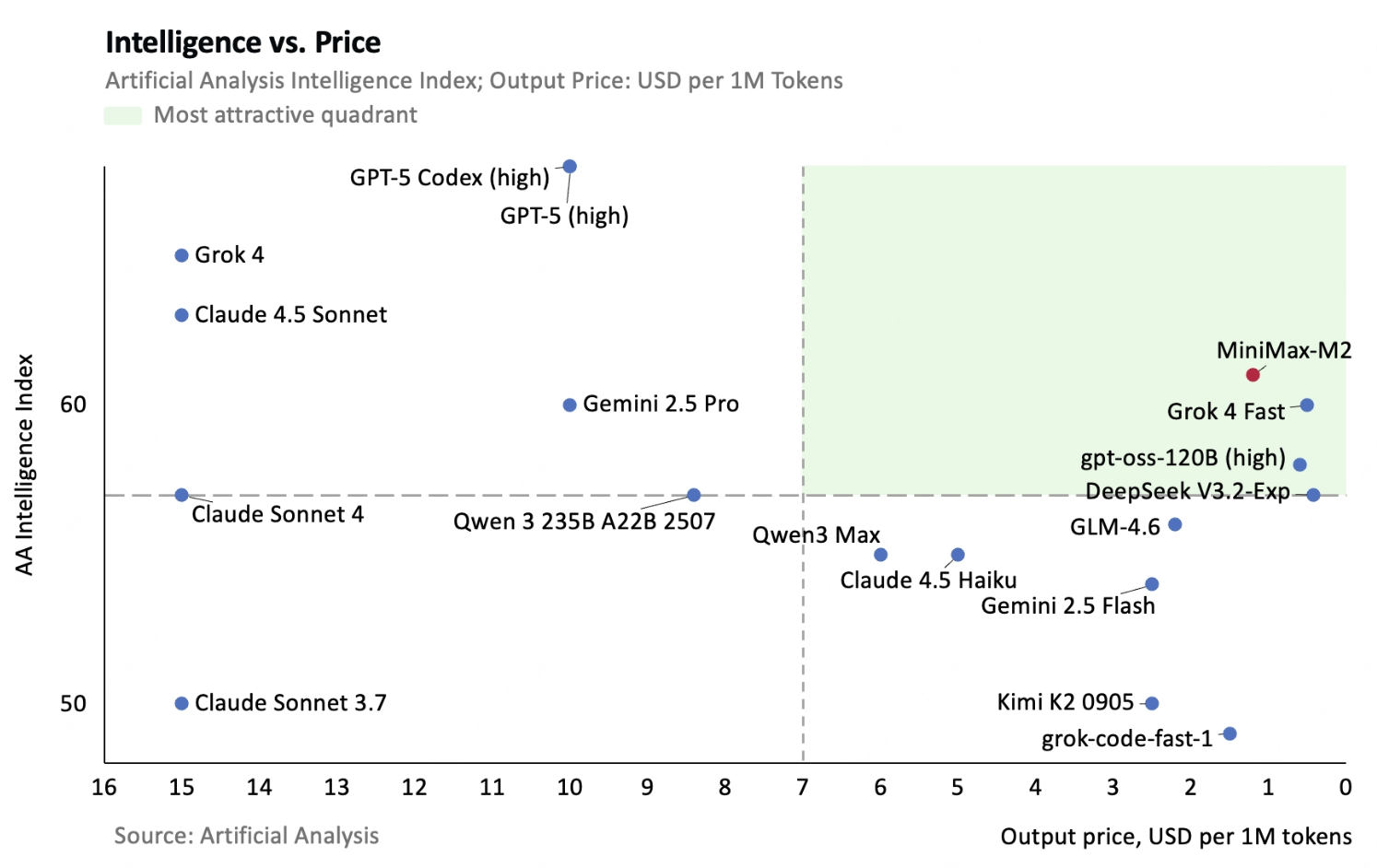
Independent evaluations rank MiniMax-M2 #1 among open models for agentic workloads across SWE-bench, Terminal-Bench, and BrowseComp.
Responses wrap reasoning in <think> tags so you can replay, redact, or condition future turns without losing context.
Day-zero support from vLLM, SGLang, and MLX lets you serve MiniMax-M2 anywhere—from cluster-scale inference to laptop experiments.
From instruction intake to audit-ready outputs
MiniMax-M2 keeps tool calls, citations, <think> traces, and final answers structured, which makes audits, safety reviews, and fine-tuning pipelines straightforward for autonomy teams.
Public scores on BrowseComp, FinSearchComp, τ²-Bench, and HLE prove MiniMax-M2 can recover from flaky tools, cite sources, and keep multi-hop reasoning grounded.
Transform filings, macro data, and internal metrics into investor-ready narratives with explicit assumptions and optional tool outputs for audit.
Review risk sampleTurn ambiguous requirements into architecture memos, dependency maps, and prioritized remediation plans with linked reasoning traces.
Draft an architecture noteSummarise and compare regional regulations, cite paragraphs inline, and highlight unresolved governance tasks for compliance teams.
Audit a policyBenchmarks that translate into production workflows
MiniMax-M2 pairs trillion-parameter capacity with a 10B active set, delivering reliable plan-act-verify behaviour across coding, browsing, and analytics agents.
69.4% on SWE-bench Verified across OpenHands and R2E-Gym scaffolds proves MiniMax-M2 can complete multi-file run–fix loops inside real repositories.
A 46.3 Terminal-Bench score (8-run mean) shows MiniMax-M2 maintaining command accuracy under 100-step limits with flaky retries accounted for.
44 BrowseComp and 48.5 BrowseComp-zh demonstrate evidence-driven browsing in English and Chinese, with citations tracked for review.
65.5 on FinSearchComp-global confirms MiniMax-M2’s ability to surface signals across filings, earnings transcripts, and macro reports.
56.5 SWE-bench Multilingual plus 36.2 Multi-SWE-Bench validate MiniMax-M2’s coverage for cross-language codebases and documentation.
75.7 GAIA (text-only) and 77.2 τ² Bench show MiniMax-M2 distilling technical papers with verifiable reasoning chains.
Provision access, instrument usage, and keep budgets predictable with token-level telemetry.
Request API credentials or pull weights, then reproduce benchmark harnesses to validate MiniMax-M2 in your environment.
Stream token, cost, and routing telemetry into your observability stack for live monitoring.
Roll out tool-aware agents with guardrails, red-team them regularly, and refine prompts or adapters as workloads grow.
MiniMax-M2 keeps quality high while giving you control over deployment, telemetry, and cost planning.
Common blockers for agent teams
Built for transparent, high-performance agents
MiniMax-M2 chat and API evaluations remain free for a limited window. Beyond the complimentary quota, usage bills at $0.50 per million input tokens and $1.50 per million output tokens with hourly metering and budget alerts.
Transparent pay-as-you-go billing for MiniMax-M2 with limited-time free access for hosted chat and API evaluation tiers.
Hosted chat and API evaluation traffic remain free during the launch window; metered rates apply once usage exceeds the complimentary quota.
Answers to the questions teams ask before shipping
Ready to build with MiniMax-M2?
Download the MiniMax-M2 weights, open MiniMax Agent, or connect the Open Platform API to bring benchmark-grade agents into your stack.